Inelastic Fracture
We have developed and implemented the Rheological models of inelastic fracture in the figure. These have been obtained via the parallel assembly of the rheological branches described in previous sections. We have further introduced a rheological “fracture element” that is assembled in series and described via the phase-field modeling of fracture.
As shown below, the Prandtl element is limited to perfect plasticity so that only the values of \(E_{prandtl}\) and \(\sigma_{0}\) are required. Linear strain hardening can be assigned to the Hooke branch and non-linear effects captured using viscoelastic Maxwell branch(es).
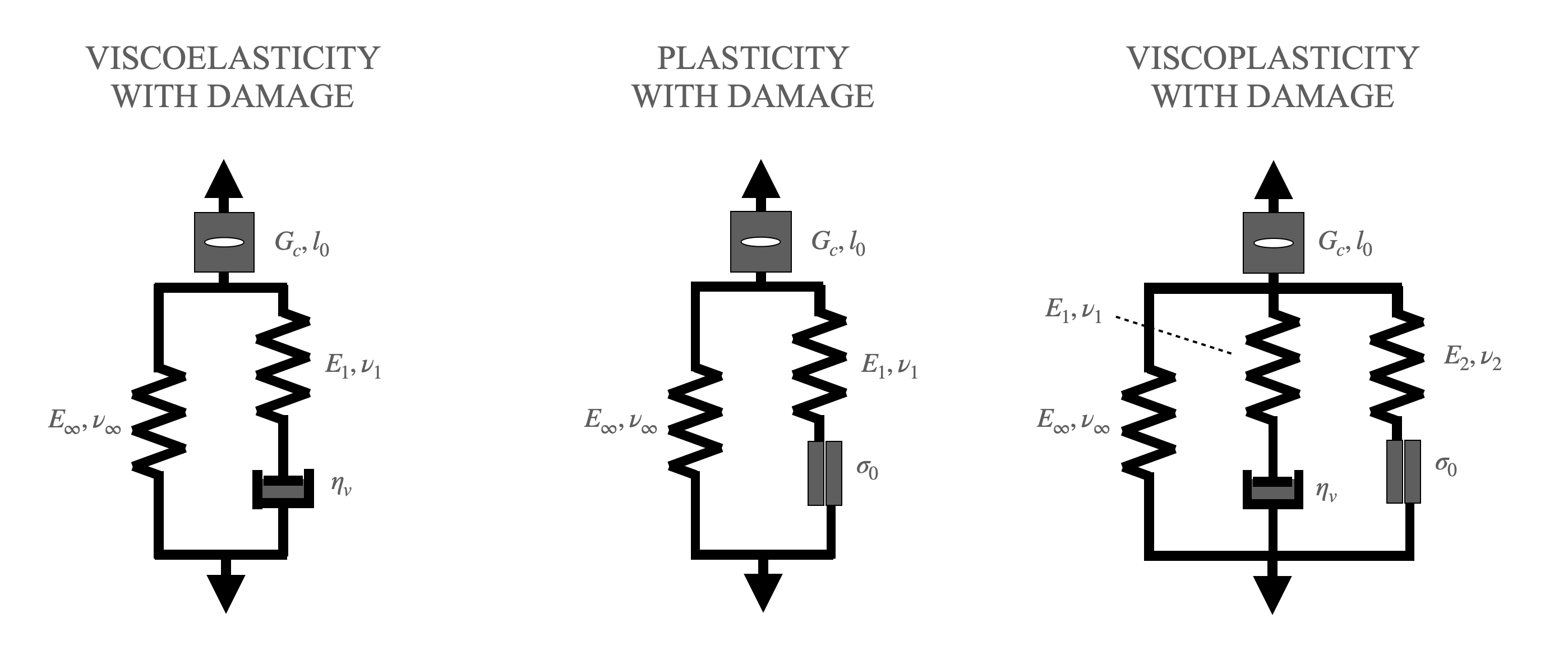
Fig. 7 Rheological models of inelastic fracture
Implementation
The stress update for the Maxwell and Prandtl branches is carried out using degraded trial quantities and the admissibility check for perfect plasticity evaluated with yield surface \(f = q^{\mathrm{tr}}(\phi) - \sigma_y = 0\). Expressions in Eq. (306) and Eq. (322) become
where \(\mu_{degr} =g(\phi)\mu\). Notably, for a Prandtl branch in the perfect plastic regime, the deviatoric stresses are independent of \(\phi\),
consistent with the serial assembly of the rheological fracture element in the proposed rheological framework.
Consistent tangent for the monolithic scheme
From Eq. (254), the linearization of the degraded Kirchhoff stress,
reads
For the viscoelastic (Maxwell) branch,
For the elastoplastic (Prandtl) element in a perfect plasticity regime,
which gives
consistent with the Prandtl contribution to \(\boldsymbol{\tau}_{\mathrm{dev}}\) being independent of \(\phi\) in such regime.
Unlike the (Hooke) branch case, for which \({\diff}_{\phi}\psi^{+} = 0\) and thus omitted in Eq. (259), we obtain
and
for the viscoelastic (Maxwell) branch and the elastoplastic (Prandtl) element in a perfect plasticity regime, respectively.
Command-line interface
To enable the Hencky viscoelastic, elastoplastic, and visco-elastoplastic models with fracture, respectively use the model option (for current conf.): -model viscolasticity-hencky-damage-principal-current, -model plasticity-hencky-damage-principal-current, and, -model viscoplasticity-hencky-damage-principal-current.
Set the corresponding material parameters listed in Hencky viscoelasticity model with damage options, Hencky plasticity model with damage options, Hencky viscoplasticity model with damage options.
Any parameter without a default option is required.
Option |
Description |
Default Value |
|---|---|---|
|
Required to enable the Hencky viscoelasticity with damage model, |
|
|
Young’s modulus in Hooke branch (i.e. a single spring), \(E_{hooke} > 0\) |
|
|
Poisson’s ratio in Hooke branch, \(\nu_{hooke} \leq 0.5\). |
|
|
Young’s modulus in Maxwell branch, \(E_{maxwell} > 0\) |
|
|
Poisson’s ratio in Maxwell branch, \(\nu_{maxwell} \leq 0.5\). |
|
|
[Deviatoric viscosity for Maxwell branch], \(\eta_\mathrm{dev} >= 0\). |
|
|
Fracture toughness expressed as critical energy release rate, \(G_c > 0\) |
|
|
Length scale parameter of phase-field model, \(l_0 > 0\) |
|
|
Residual stiffness in full fracture state (\(\phi = 1\)), \(\eta > 0\) |
|
|
Viscosity for viscous regularization of damage problem, \(\zeta >= 0\) |
|
|
Scaling parameter, \(c_0 > 0\) |
|
|
True: AT1 model, False: AT2 |
True |
|
True: full Jacobian, False: Jacobian diagonal terms only (for quasi-Newton methods), |
True |
An example using the Hencky viscoelasticity with damage model can be run via
./bin/ratel-quasistatic -options_file examples/ymls/ex02/viscoelasticity-hencky-damage-initial-principal.yml
Option |
Description |
Default Value |
|---|---|---|
|
Required to enable the Hencky plasticity with damage model, |
|
|
Young’s modulus in Hooke branch (i.e. a single spring), \(E_{hooke} > 0\) |
|
|
Poisson’s ratio in Hooke branch, \(\nu_{hooke} \leq 0.5\). |
|
|
Young’s modulus in Prandtl branch, \(E_{prandtl} > 0\) |
|
|
Poisson’s ratio, \(\nu_{prandtl} \leq 0.5\). |
|
|
Initial yield stress threshold, \(\sigma_0 > 0\) |
|
|
Fracture toughness expressed as critical energy release rate, \(G_c > 0\) |
|
|
Length scale parameter of phase-field model, \(l_0 > 0\) |
|
|
Residual stiffness in full fracture state (\(\phi = 1\)), \(\eta > 0\) |
|
|
Viscosity for viscous regularization of damage problem, \(\zeta >= 0\) |
|
|
Scaling parameter, \(c_0 > 0\) |
|
|
True: AT1 model, False: AT2 |
True |
|
True: full Jacobian, False: Jacobian diagonal terms only (for quasi-Newton methods), |
True |
An example using the Hencky plasticity with damage model can be run via
./bin/ratel-quasistatic -options_file examples/ymls/ex02/plasticity-hencky-damage-initial-principal.yml
Option |
Description |
Default Value |
|---|---|---|
|
Required to enable the Hencky viscoplasticity with damage model, |
|
|
Young’s modulus in Hooke branch (i.e. a single spring), \(E_{hooke} > 0\) |
|
|
Poisson’s ratio in Hooke branch, \(\nu_{hooke} \leq 0.5\). |
|
|
Young’s modulus in Maxwell branch, \(E_{maxwell} > 0\) |
|
|
Poisson’s ratio in Maxwell branch, \(\nu_{maxwell} \leq 0.5\). |
|
|
Young’s modulus in Prandtl branch, \(E_{prandtl} > 0\) |
|
|
Poisson’s ratio, \(\nu_{prandtl} \leq 0.5\). |
|
|
[Deviatoric viscosity for Maxwell branch], \(\eta_\mathrm{d} >= 0\). |
|
|
Initial yield stress threshold, \(\sigma_0 > 0\) |
|
|
Fracture toughness expressed as critical energy release rate, \(G_c > 0\) |
|
|
Length scale parameter of phase-field model, \(l_0 > 0\) |
|
|
Residual stiffness in full fracture state (\(\phi = 1\)), \(\eta > 0\) |
|
|
Viscosity for viscous regularization of damage problem, \(\zeta >= 0\) |
|
|
Scaling parameter, \(c_0 > 0\) |
|
|
True: AT1 model, False: AT2 |
True |
|
True: full Jacobian, False: Jacobian diagonal terms only (for quasi-Newton methods), |
True |
An example using the Hencky viscoplasticity with damage model can be run via
./bin/ratel-quasistatic -options_file examples/ymls/ex02/viscoplasticity-hencky-damage-initial-principal.yml